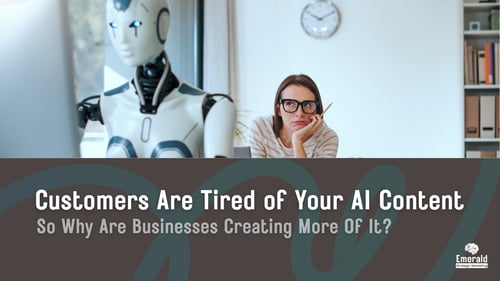
Customers Are Tired of AI Content. So Why Are Businesses Creating More of It?
If you’re a CEO right now, you’re hearing the same message on repeat:
“AI will replace marketing teams.”
It sounds disruptive. It sounds urgent. It sounds like a cost-saving opportunity. It’s also mostly wrong.
AI isn’t replacing marketing. It’s exposing where marketing wasn’t working in the first place.
And for B2B organizations, that distinction matters because the companies treating AI as a shortcut are the ones about to find out how weak their strategy actually is. 😬
The Real Shift: From Content Creation to Strategic Clarity
Marketing teams are no longer constrained by production. AI can generate blogs, campaigns, emails, and even visual assets in seconds (although we personally think this last one has a little more way to go before it's perfected).
That removes the bottleneck but it also removes the excuse.
Instead of asking: “Can we create enough content?”
The question has become: “Is what we’re saying actually differentiated, relevant, and aligned?”
Here’s where most teams are getting exposed:
- Generic positioning becomes obvious at scale
- Inconsistent messaging multiplies across channels
- Weak value propositions get amplified, not fixed
AI doesn’t create strategy. It amplifies whatever already exists - good or bad.
And if your messaging was already average (and so much of B2B messaging is), AI will just make you consistently average… faster.
Why AI in B2B Marketing Amplifies Weak Positioning
AI-powered tools are now standard across marketing teams; used for targeting, personalization, and campaign optimization. But there’s a critical misunderstanding happening at the leadership level:
AI doesn’t fix positioning. It operationalizes it.If your brand:
- Sounds like everyone else (we see this all the time!)
- Targets everyone instead of a clear buyer persona (also a really common issue)
- Lacks a compelling point of view
Then AI will:
- Scale generic messaging
- Improve efficiency of irrelevant campaigns
- Accelerate wasted spend
This is why many organizations are seeing more activity, but not more impact.
Even with widespread adoption, many companies still struggle to translate AI usage into measurable results, because the underlying strategy isn’t there.
How to Use AI in Marketing Without Damaging Your Brand
Most organizations are approaching AI backward. They start with:
- Tools
- Automation
- Content generation
And only later ask:
- What are we actually trying to say?
That’s how you end up with volume instead of value.
Here’s what to do instead:
1. Lock Your Positioning Before You Scale Content
AI relies on patterns. If your positioning isn’t clear, it will default to industry averages.
Define:
- Your category/industry stance
- Your unique differentiation
- The specific problems you solve (not just services you offer)
2. Treat AI as an Operator, Not a Strategist
AI is excellent at:
- Data analysis
- Content generation
- Workflow automation
It is not responsible for:
- Strategic direction
- Messaging decisions
- Brand voice
AI scales execution. Humans own judgment.
3. Build Guardrails for Messaging and Voice
Without structure, AI introduces:
- Voice inconsistency
- Generic tone
- Misalignment across campaigns
In fact, maintaining authentic brand voice is one of the biggest challenges teams face with AI-generated content.
This isn’t a prompt issue. It’s an operational one.
Your AI Content Marketing Strategy Is Only as Strong as Your Foundation
The biggest mistake companies are making right now is assuming AI equals strategy.
It doesn’t.
An effective AI content marketing strategy requires:
- Clear audience segmentation
- Defined messaging hierarchy
- Consistent voice and tone
- Alignment with sales and pipeline goals
Without that, you get:
- Faster content production
- Lower engagement
- Increased sameness across competitors
AI has lowered the barrier to entry for content creation. That means differentiation is now entirely strategic, not tactical.
And that’s why weak strategies are becoming visible so quickly.
The CEO’s Role: Protecting Brand Voice in an AI-First World
This is where leadership becomes critical.
AI governance isn’t a marketing task, it’s a business decision.
CEOs are responsible for:
- Defining risk tolerance in AI usage
- Ensuring cross-functional alignment (marketing, legal, IT)
- Protecting brand integrity at scale
Because here’s the reality:
AI doesn’t just scale output.
It scales your brand voice, accurate or not.
And brand voice isn’t a “nice to have.” It’s directly tied to trust, differentiation, and reputation.
Leadership communication itself is part of that equation. A consistent CEO voice strengthens brand clarity and credibility across the market.
If your internal messaging is fragmented, AI won’t hide it.
It will make it more visible.
Before You Hire Tools, You Need Strategy
There’s a reason many AI initiatives underperform:
- Teams adopt tools without defined outcomes
- Content increases without improving performance
- Data expands without improving decision-making
The issue isn’t capability, it’s alignment.
AI should be integrated into a strategy-led system, not layered onto a broken one.
Organizations that succeed with AI:
- Start with business outcomes
- Align marketing to revenue goals
- Build systems around decision-making, not just execution
Those that don’t end up with what we’re already seeing across the market:
More content.
Less impact.
Where a Marketing Strategy Consultant Actually Adds Value
This is the moment where a marketing strategy consultant becomes less about execution, and more about clarity.
Because the real problem isn’t:
- “We don’t have enough content”
It’s:
- “We don’t know what we stand for in the market”
A strong strategy partner helps you:
- Refine positioning before scaling content
- Align messaging across sales and marketing
- Define AI’s role based on business goals—not trends
AI makes execution easier.
It also makes strategy, or the lack of it, impossible to ignore.
Bottom Line
AI didn’t kill marketing teams.
It removed the buffer that used to hide weak strategy.
Now:
- Positioning matters more
- Messaging consistency matters more
- Leadership alignment matters more
Because what used to get buried in low volume now gets amplified at scale.
The companies that win won’t be the ones using the most AI.
They’ll be the ones with the clearest strategy behind it.
FAQ
1. Will AI replace my marketing team?
No. AI is changing what marketing teams do, not eliminating them. It automates execution (content creation, analysis, personalization), but strategy, positioning, and brand decisions still require human leadership.
2. How should CEOs approach AI in marketing without risking the brand?
Start with governance and strategy, not tools. Define:
- Where AI will be used
- Where human oversight is required
- How brand voice and compliance will be protected
Without this structure, AI introduces risk rather than value.
3. Why isn’t AI improving our marketing results yet?
Because AI doesn’t fix foundational issues. If your messaging, targeting, or positioning is unclear, AI will scale those problems. Many organizations face this gap, high AI adoption with limited impact, because the strategy wasn’t solid first.