Thought Leadership That Builds Trust and Drives Business
AI isn’t just changing how buyers search. It’s changing who does the searching.
We’re entering a new era of agentic buying in B2B, where AI tools are no longer just passive assistants. They are actively helping evaluate options and even shortlist vendors... often before a human buyer ever visits your website.
This shift has major implications for how businesses position themselves online.
What Is Agentic Buying?
Agentic buying refers to AI-driven workflows where software tools are tasked with:
- Researching potential vendors
- Comparing options based on defined criteria
- Narrowing down choices to a shortlist
Instead of a person manually browsing websites, reading blogs, and filling out forms, AI systems are now doing much of the early-stage evaluation on their behalf.
That means your content is no longer just speaking to human readers; it’s being interpreted, filtered, and scored by machines.
The Critical Shift Most Companies Aren’t Accounting For
Here’s where many B2B organizations are falling behind:
👉 AI doesn’t browse your website the way a human does
👉 It doesn’t “experience” your brand or design
👉 It parses your content for clear, structured, high-signal information
In other words, AI is not impressed by clever messaging or visual storytelling alone. It is looking for:
- Clarity
- Consistency
- Structured data
- Crediability
- Easily extractable value
If your content isn’t built for this, your company may never even make it into consideration.
Why Visibility Now Depends on Machine Understanding
Traditional SEO focused on helping your business get found in search results.
That’s still important, but it’s no longer the full picture.
Today, visibility increasingly depends on how well AI systems can:
- Interpret what you offer
- Categorize your services
- Compare your value against competitors
If your messaging is vague, unstructured, or buried in long-form content without clear hierarchy, AI may struggle to understand it and skip over you entirely.
What This Looks Like in the Real World
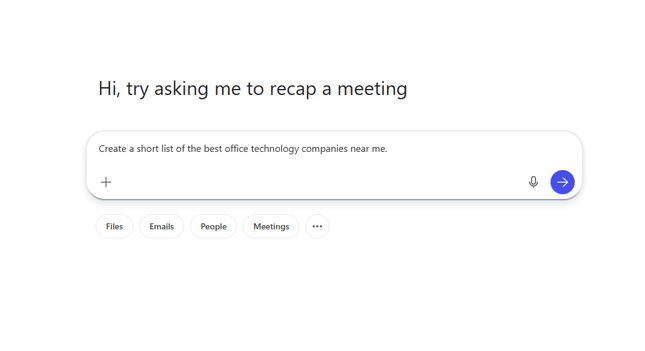
Here's a great example. A buyer asks ChatGPT: “Best managed IT providers for manufacturing companies in Tampa”
AI pulls:- Structured service pages
- Reviews and third-party mentions
- Clear industry specialization
👉 This reinforces a key truth: If AI can’t validate your credibility, you never enter consideration.
What AI Sees vs. What You Think It Sees
Before (typical B2B copy):
“Transforming your organization through tailored technology solutions”
After (AI-readable):
“ERP implementation and managed IT services for manufacturing companies with 50–500 employees”
Before:
“Helping businesses scale efficiently”
After:
“Reduced IT downtime by 42% for multi-location distribution companies”
👉 AI doesn’t interpret intent. It scores clarity.
How to Know If Your Site is AI-Readable
If you want a fast gut check, start here:
- Can a tool identify exactly what you sell in 5 seconds?
- Are your services clearly named (not branded phrases)?
- Do you list industries and use cases explicitly?
- Can pricing, integrations, or capabilities be found without digging?
- Are outcomes quantified anywhere?
If you hesitate on any of these, you’re not just unclear. You may already be getting filtered out.
Building Websites for AI + Humans
To stay competitive, your marketing strategy needs to evolve.
Here are the key areas to focus on:
1. Clearly Structured Service Pages
- Define exactly what you offer
- Use consistent terminology
- Break information into logical sections
- Avoid overly abstract or brand-heavy language
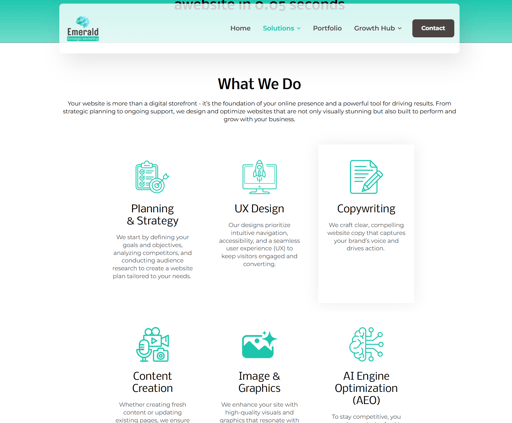
Below is an example of a well-structured service page. This page is from the Emerald website design and optimization page. In this example, you'll see a clear H2 header - What We Do - and then the first 6 of 12 sections on what makes up the website design and optimization service using H3 headers. This structure is important for AI to read and organize your pages. And it also makes it easier for humans to quickly skim and find what they are looking for.
2. Accessible, Well-Organized Information
- Make technical details easy to find
- Use headings, bullet points, and summaries
- Ensure key information is not buried deep in paragraphs
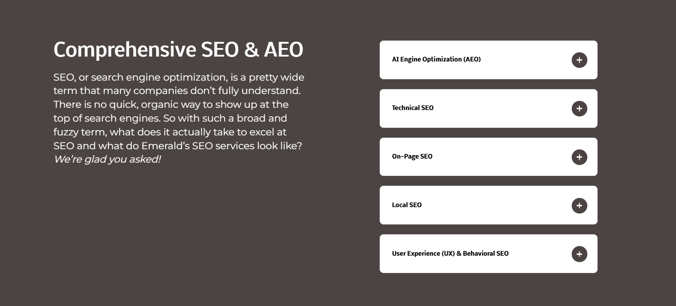
Below is an example of how a website can be organized to allow both humans and AI easy access to the information they are looking for. In this case, we used an accordion function to keep the information hidden until it is clicked. This reduces clutter and makes the page easier to navigate.
3. Transparent Proof Points and Differentiators
- Clearly state what sets you apart
- Include measurable outcomes where possible
- Social proof that shows your expertise and trustworthiness
- Highlight industries, use cases, and specialties
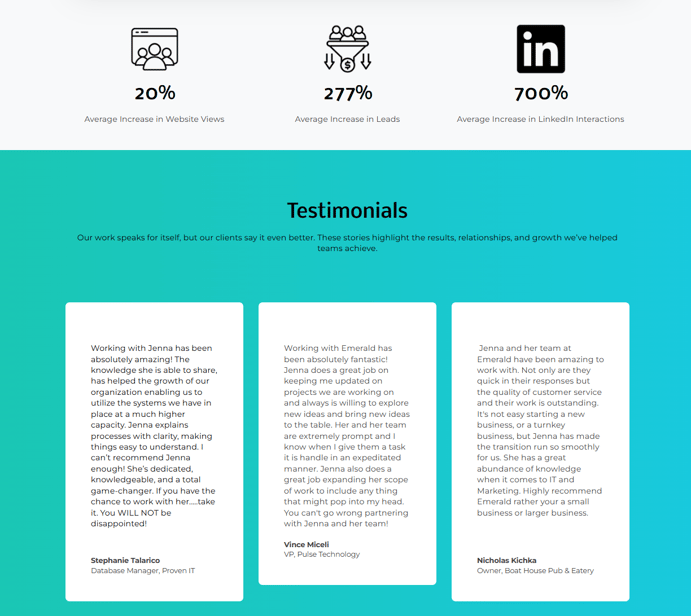
The example below shows two forms of social proof. One are measurable results from real clients Emerald has worked with. The second are the testimonials of a handful of clients. These both show authority and credibility. Not only to visitors, but also AI.
4. Content That’s Easy to Parse
- Use clean formatting and logical hierarchy
- Avoid unnecessary complexity
- Focus on clarity over cleverness
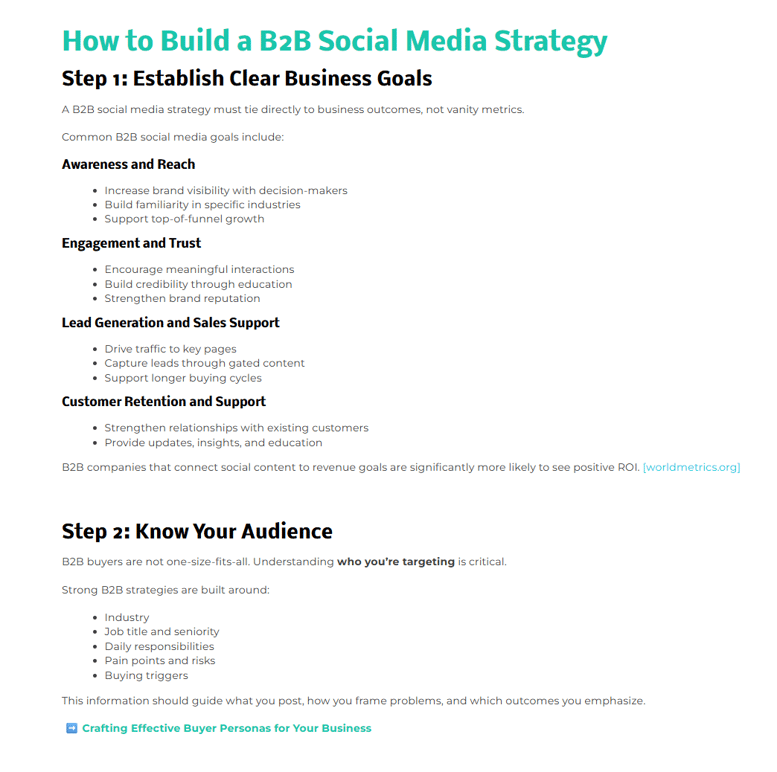
Below is an example of logical hierarchy and keeping content simple. You'll see that this section of the blog has a clear H2 header - "How to Build a B2B Social Media Strategy" - followed by each step listed as an H3 header and any additional details sectioned into H4 headers. This keeps the content simply to read for humans and logical for AI bots.
What to Do Next (Your 90-Day Plan)
If you’re thinking, “Okay, but where do I start?”... here’s the playbook.
Month 1: Audit
- Review service pages for clarity
- Identify vague language
- Find missing proof points
- Evaluate structure and readability
Month 2: Fix the Core Pages
- Rewrite services with explicit definitions
- Add industries and use cases
- Break content into scannable sections
- Surface key details (don’t bury them)
Month 3: Build Supporting Content
- Add FAQ sections
- Create comparison content
- Publish proof-driven blogs
- Expand use cases and industry pages
The Risk of Being Overlooked
If your website content isn’t easy for AI systems to interpret:
- You may not appear in AI-generated recommendations
- You may not make the vendor shortlist
- You may lose opportunities before a conversation even starts
This isn’t a future concern; it’s already happening as AI tools become embedded in buying workflows.
The Bottom Line
It’s not just about being found anymore.
It’s about being:
- Machine-readable
- Structurally clear
- Credible and easy to evaluate
The companies that adapt to this shift early will have a significant advantage in how they’re discovered, considered, and selected.
FAQ: What Leaders Are Asking Right Now
What is agentic buying in B2B?
It’s when AI tools actively research, evaluate, and shortlist vendors on behalf of buyers instead of buyers doing that work themselves manually.
Does SEO still matter?
Yes, but it’s evolving.
It’s no longer just about ranking.
It’s about whether AI can understand and recommend your content.
What makes content “AI-readable”?
Content that is:
- Clear
- Structured
- Specific
- Easy to extract and verify
How do I know if AI can interpret my website?
If your messaging relies on interpretation, storytelling, or vague positioning, AI will likely struggle. If your value is explicit and structured, AI can evaluate it.
Is this only impacting large companies?
No. In fact, smaller companies often lose visibility faster because they rely more on messaging and less on structured authority signals.