
The Real Reason Marketing Feels Harder This Year
Environmental and conservation organizations (and most non-profits, honestly) rarely have a shortage of evidence. They have wildlife surveys, water-quality reports, restoration benchmarks, climate projections, volunteer data, policy research, and years of firsthand experience.
Yet the public does not automatically act because the evidence is strong.
Facts establish what is true. Stories help people understand why that truth matters. A well-designed path to action shows them what they can realistically do next. Research on climate communication, narrative persuasion, hope, and behavioral engagement consistently suggests that knowledge is important, but it is only one factor shaping attitudes and behavior. Narratives can improve comprehension and engagement, while efficacy, social context, trust, values, and practical barriers influence whether engagement becomes action.
That distinction matters for leaders evaluating their nonprofits marketing strategies. The goal is not to replace evidence with emotion. It is to connect evidence, emotional relevance, and agency without exaggerating the science or manipulating the audience.
Why Don’t Facts Alone Motivate Environmental Action?
Facts alone often fail because information is not the same as personal meaning.
People may understand that a habitat is shrinking without seeing how the loss affects a place they love. They may accept that climate change is serious without believing that their actions, or anyone’s actions, will make a meaningful difference. They may encounter a statistic so large that it becomes difficult to picture. They may also agree with the evidence but face financial, political, social, or practical barriers to acting on it.
This is why the traditional “information deficit” approach is incomplete. That approach assumes that if the public receives enough accurate information, people will change their beliefs or behavior. Science-communication research criticizes that model for oversimplifying the relationship between knowledge and action, particularly around polarized or complex subjects such as climate change.
The better strategic question is not, “How do we make people care instead of giving them facts?”
It is, “How do we make the facts understandable, personally meaningful, trustworthy, and actionable?”
Facts and Emotional Connection Are Not Opposites
Environmental nonprofits should not choose between evidence and emotion. Each performs a different job.
Evidence provides credibility and scale. It tells people whether a problem is real, how conditions are changing, what interventions have been tested, and whether an organization’s work is producing measurable progress.
Emotional connection creates relevance. It helps an audience picture the consequences of that evidence, connect it with existing values, and imagine a role for themselves in the outcome. Narrative science research finds that stories can increase comprehension, interest, and engagement among nonexpert audiences, but it also warns that the persuasive power of narrative creates ethical responsibilities for communicators.
The mistake is treating a story as proof. A compelling account from one volunteer, scientist, landowner, or community member cannot establish that a program works across an entire population. Conversely, a regional dataset may establish scale without helping someone understand what the change feels like on the ground.
Strong marketing for nonprofits uses both:
- The story illustrates the meaning of the evidence.
- The evidence shows whether the story reflects a broader pattern.
- The call to action connects both to a credible response.
That combination is more defensible than the popular assumption that simply showing one identifiable individual will automatically increase support. Recent preregistered and large-sample studies found that greater identifiability increased some emotional reactions but did not consistently increase donations. Researchers have consequently urged caution around treating the “identifiable victim effect” as a universal fundraising rule
Make the Scale Understandable, Not Smaller
Large environmental numbers are often difficult to process: millions of acres, thousands of species, decades of projected loss, or tons of debris. But the answer is not to hide the scale.
Instead, provide an understandable unit and then reconnect it to the full picture.
For example:
During one shoreline survey, volunteers counted 426 plastic bottle caps along a two-mile section of beach. Across the statewide dataset, bottle caps were among the most frequently recorded items.
The first sentence gives the audience something concrete to visualize. The second prevents the individual example from being mistaken for the entire body of evidence.
Research on charitable decision-making suggests that people can be insensitive to the size of a problem, but recent work also shows that techniques that help people consider a smaller unit before confronting the larger total can improve sensitivity to scale. The findings are not a license to oversimplify; they are a reason to translate large numbers into comprehensible units while preserving the total context.
Storytelling Works Best When the Audience Can See Agency
Many environmental stories stop at awareness:
- The reef is deteriorating.
- The wetland is disappearing.
- The species is threatened.
- The community is facing greater flood risk.
Those are important stakes. But stakes without a credible response can leave people concerned and uncertain about what to do.
A 2022 meta-analysis of 158 comparisons involving 19,736 participants found that fear appeals had a stronger influence on behavioral outcomes when they included positive response-efficacy information, information showing that the recommended action could help address the threat. However, most studies in that analysis concerned health, and the subset of environmental messages produced a much smaller average effect. Environmental nonprofit leaders should therefore resist simplistic claims that fear either “always works” or “never works.”
The practical takeaway is clearer: If you describe a threat, explain the response.
Do not say only, “Plastic is killing marine wildlife.” Explain which intervention reduces dangerous litter, what evidence supports it, and what the audience can do, join a cleanup, document debris, support a specific policy, contact a decision-maker, or fund a tested program.
Hope requires similar discipline. A 2023 meta-analysis covering 46 climate-engagement studies found only a small average effect from interventions intended to increase hope. Hope associated with people’s ability to take action was more strongly related to engagement than vague hope that the climate problem would somehow improve. The authors also noted that much of the literature measured intentions rather than sustained behavior.
In other words, “Everything will be fine” is not a strategy. “Here is a meaningful action, here is why it works, and here is how you can participate” is much more useful.
Seven Evidence-Based Principles for Better Environmental Stories
1. Begin With Meaning, Then Introduce the Number
Opening with five statistics forces the audience to interpret the issue before they understand why it matters. A stronger opening gives the reader a person, place, species, decision, or visible change, and then introduces the evidence that explains its significance.
A climate-communication experiment conducted across three studies found that story-structured messages generated greater narrative engagement and, in two studies, more pro-environmental behavior than informational narratives. That supports using narrative structure, but it does not mean every story will outperform every factual message in every context.
2. Choose a Protagonist With a Real Stake
A protagonist does not have to be a person. It may be:
- A coastal community preparing for recurrent flooding
- A volunteer documenting debris
- A farmer changing land-management practices
- A threatened species moving through a restored corridor
- A river recovering after pollution controls
- A scientist trying to answer a consequential question
The protagonist gives the audience a perspective through which to understand change. If people or communities are featured, obtain meaningful consent, preserve context, and avoid reducing anyone to hardship. Ethical nonprofit storytelling favors strengths, agency, ongoing consent, and storytellers who remain the heroes of their own experiences rather than props in the organization’s fundraising narrative.
3. Define Specific Stakes
“Biodiversity is declining” is accurate but abstract. Explain what could be lost, protected, restored, or changed, and for whom.
Specificity might include:
- A nesting season
- A drinking-water source
- A culturally important shoreline
- A local fishery
- A neighborhood’s tree canopy
- A wildlife corridor connecting two protected areas
Specific stakes help audiences understand the connection between the evidence and everyday life. Research on psychological distance is mixed, so proximity should not be treated as a guaranteed behavioral lever. However, a growing body of environmental communication work finds that immediate, socially relevant, and locally applicable information can affect risk perception, discussion, and engagement.
4. Connect the Story to Shared Values
Different audiences may care about the same conservation outcome for different reasons: stewardship, public health, local identity, economic resilience, recreation, fairness, faith, responsibility to future generations, or protection of wildlife.
This does not mean changing the facts to fit an audience. It means starting where the audience already has a reason to listen. An organization protecting an estuary might emphasize fisheries with one audience, flood resilience with another, and wildlife habitat with a third, all while relying on the same underlying science.
5. Show Both the Threat and the Path Forward
Do not erase urgency. Do not manufacture optimism either.
Describe:
- What is happening
- What is at risk
- What response is available
- Why that response is credible
- What role the audience can play
Research on hope and fear suggests that emotional messages are highly dependent on content and context. Hope centered on action is more promising than generalized optimism, while threatening messages are more effective when paired with a response shown to address the threat.
6. Use Evidence as the Story’s Backbone
Ask a scientist or program lead to verify:
- The source of every number
- The period covered
- The geographic scope
- Whether a result is measured, modeled, projected, or self-reported
- Whether uncertainty needs to be disclosed
- Whether the story represents a typical outcome or an exceptional one
- Whether the organization can legitimately claim attribution
Use precise language. “Our volunteers documented” is different from “our campaign caused.” “Participants reported greater confidence” is different from “the exhibit changed behavior.” Scientific credibility depends on maintaining those distinctions even when the simpler claim sounds more impressive.
7. Attach One Clear Action to the Narrative
The action should feel like the next chapter, not an unrelated button added at the end.
If the story concerns volunteer-collected water samples, ask the audience to join the next monitoring day. If it concerns a policy decision, provide the specific public-comment action. If it concerns a restoration site, explain what a contribution funds. If it concerns social silence, ask the audience to start or share a conversation.
Rare’s tested social-media campaigns illustrate why this matters. Its storytelling videos generated substantial viewership, but donation outcomes differed considerably depending on the clarity of the ask, platform, audience, and checkout friction. A 60-second peatlands video received more than 812,000 views but produced 406 click-throughs and 42 donations; another video with a clearer donation incentive generated 1,300 click-throughs and 73 donations from roughly 404,000 views. Storytelling gained attention, but the conversion path determined how much of that attention became support.
A Practical Framework
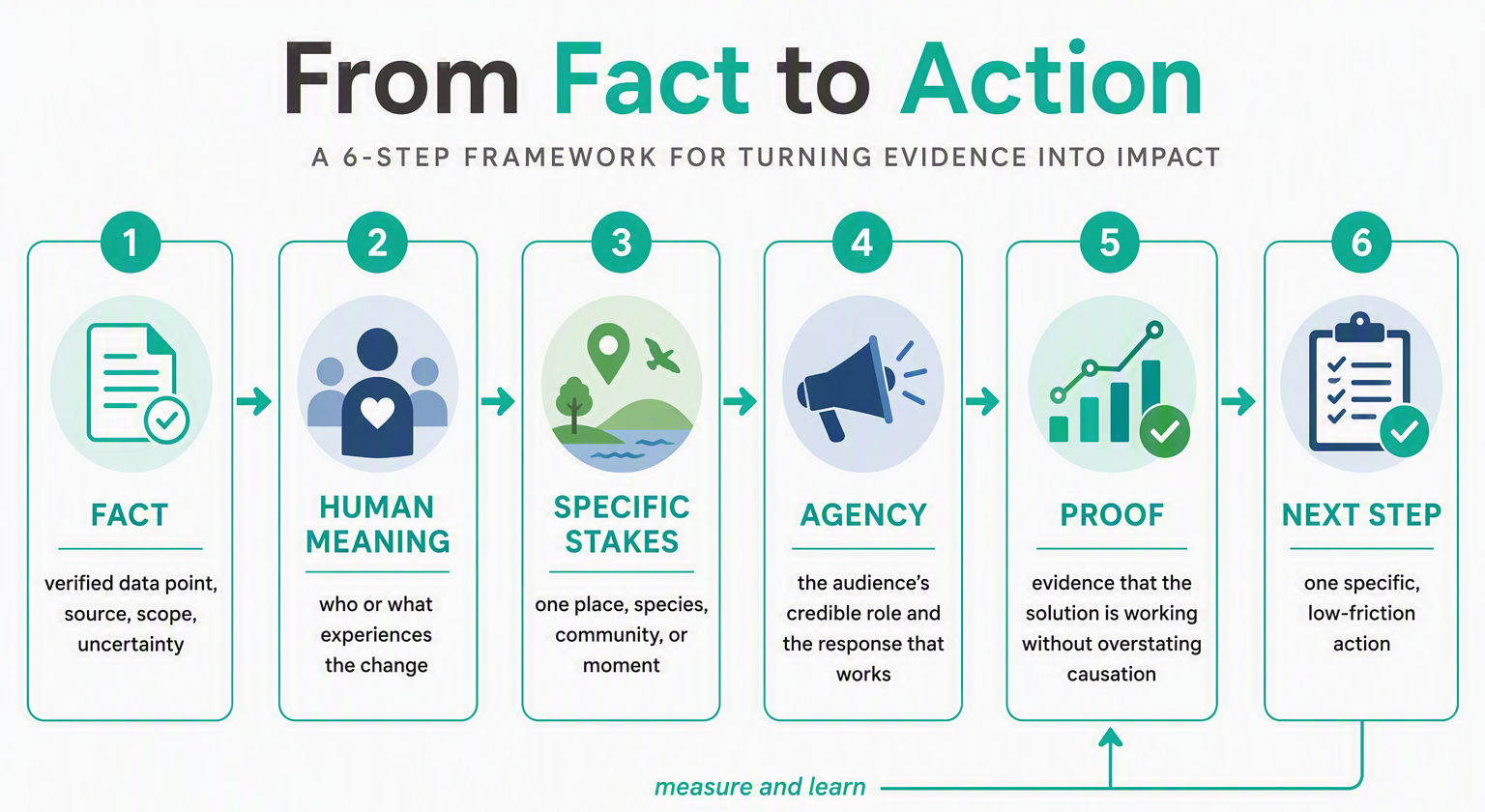
Use this six-stage process when developing a campaign, appeal, impact article, video, email, or advocacy message.
1. Fact: What do we know?
Write the finding in plain language. Record the source, timeframe, scope, and uncertainty before writing creative copy.
2. Human Meaning: Who or what experiences this change?
Identify the community, species, landscape, volunteer, researcher, or decision affected by the evidence.
3. Specific Stakes: What becomes possible or impossible?
Define a visible consequence. Avoid jumping immediately from a local data point to a global conclusion.
4. Agency: What response can influence the outcome?
Name the intervention, who can take it, and why it is relevant.
5. Proof: What evidence suggests the response is working?
Use program results, peer-reviewed research, policy outcomes, trend data, or carefully labeled participant experience.
6. Next Step: What should the audience do now?
Provide one primary action. Make it specific, proportionate, and easy to complete.
The following framework illustrates how those six elements create a continuous path from verified evidence to measurable public engagement.
Example: From Wetland Data to Public Action
Fact: Annual monitoring found that native marsh vegetation increased across 14 restored acres.
Human meaning: A nearby community depends on the wetland for storm-buffering, recreation, and wildlife habitat.
Specific stakes: The next phase would reconnect an additional section of degraded shoreline.
Agency: Volunteers can help install native plants; donors can fund materials; residents can support the required local approval.
Proof: Show the monitoring method, the measured vegetation change, and any limits on what the assessment can conclude.
Next step: “Register for the October planting day” is stronger than “Help us save wetlands.”
This structure works because the evidence remains visible while the audience receives a concrete role.
What Environmental Nonprofits Can Learn From Real Campaigns
The Climate Museum: Pair Information With Social Meaning and Civic Action
The Climate Museum’s “The End of Fossil Fuel” exhibition combined scientific information, art, maps, historical context, social-norm information, reflection spaces, and concrete civic-action opportunities such as postcards and an action-commitment wall.
A peer-reviewed evaluation collected 1,273 initial surveys, 143 follow-up surveys, and 39 interviews. Five outcomes were significantly higher at follow-up, including hope, confidence and determination to discuss climate change, understanding of collective action, and recognition that other people were concerned. Visitors frequently cited climate justice, fossil-fuel-industry influence, and public concern as takeaways they planned to share.
The limitations are equally instructive. More than 80% of surveyed visitors were already in the “Alarmed” climate segment, follow-up retention was 11.2%, the study lacked a controlled comparison group, and it did not measure actual behavior. The responsible lesson is not that the exhibition “caused climate action.” It is that integrated experiences can affect psychological precursors to engagement and give already-concerned audiences more confidence, agency, and language for conversation.
Ocean Conservancy: Let Participants Create the Evidence
Ocean Conservancy’s International Coastal Cleanup turns volunteers into both protagonists and data contributors. In 2025, 630,069 volunteers recorded more than 13.8 million pieces of litter. Across four decades, the initiative reports nearly 440 million recorded trash items and data cited by approximately 300 peer-reviewed studies.
The model connects action at several levels: a person removes and records an item; the growing dataset reveals patterns; researchers use the data; and policymakers can evaluate interventions. A 2025 peer-reviewed analysis using cleanup data found that plastic-bag policies were associated with a 25% to 47% reduction in plastic bags as a share of litter collected relative to places without those policies. The campaign does not ask volunteers merely to hear a statistic. It allows them to help produce evidence that can inform larger solutions.
#TeamTrees: Give a Large Goal a Simple Unit
#TeamTrees presents a global reforestation effort through one understandable unit: one dollar funds one tree. Its website reports more than 25 million trees funded, over 800,000 donors, and planting activity across 104 locations in partnership with the Arbor Day Foundation.
The lesson is not that every conservation effort can be reduced to a one-dollar equation. Many interventions are more complex. The lesson is that a clear unit can make scale easier to grasp when the organization also explains implementation, locations, partners, and how reported impacts are calculated.
Common Storytelling Mistakes That Weaken Public Engagement
Leading With a Wall of Statistics
Numbers without context demand interpretation before relevance has been established. Use one meaningful number, translate it into a comprehensible unit, and provide the full dataset or methodology for readers who need more depth.
Using Doom Without an Effective Response
Threat can attract attention, but threat alone is not a reliable strategy. Explain which response can reduce the danger and what evidence supports it.
Treating Emotion as Proof
A moving story may demonstrate why an issue matters. It cannot demonstrate program effectiveness, representativeness, or causation by itself. Pair the story with appropriate evidence and limitations.
Making the Organization the Hero
Communities, volunteers, scientists, partners, and local leaders usually carry the work. Position the organization as a facilitator, resource, connector, or advocate—not the rescuer. Strengths-based storytelling protects dignity and creates a more accurate account of how conservation happens.
Adding a Generic Call to Action
“Learn more,” “make a difference,” and “save the planet” leave the audience to determine the next step. Rare’s campaign evaluation showed that explicit donation language and lower-friction links mattered in converting attention into support.
Confusing Engagement With Impact
Views, likes, emotional reactions, intentions, registrations, donations, volunteer attendance, policy contacts, and environmental outcomes are different measurements. Track them separately. Researchers evaluating the Climate Museum explicitly noted that improvements in hope and discussion confidence should not be interpreted as measured behavioral change.
Better Storytelling Is Better Strategy
For environmental and conservation nonprofits, storytelling is not decoration added after the science is complete. It is the strategic work of helping people understand the science, connect it to values, see credible agency, and take a relevant next step.
The strongest approach is neither facts versus emotion nor fear versus hope. It is:
accurate evidence + specific human meaning + credible agency + a connected action.
That is the standard nonprofit leaders should expect from their internal communications teams, consultants, or a digital marketing agency for nonprofits. The work should preserve scientific credibility, respect the people and communities represented, and produce more than attention. It should create a clear path from understanding to participation.

________________________________________________________________
Frequently Asked Questions
1. Should an environmental nonprofit lead with a story or a statistic?
Lead with whichever element makes the issue immediately understandable to the intended audience, but connect the two quickly. A story can establish relevance; a statistic can establish scale and credibility. Do not use one personal example as proof of a broad trend, and do not publish an abstract number without explaining what it changes for a person, place, species, or community.
2. Can fear-based environmental messaging motivate action?
Sometimes, but the evidence is context-dependent. Fear appeals perform better when the message identifies a response that can effectively reduce the threat. Environmental studies show smaller and more variable effects than many health-focused studies, so test the message with your audience and avoid assuming that greater fear will automatically create greater action.
3. How can a nonprofit tell an emotional story without manipulating people?
Use verified facts, disclose important uncertainty, obtain meaningful and ongoing consent, preserve the storyteller’s agency, avoid reducing people to hardship, and connect emotion to an honest account of solutions and limitations. The objective is not to manufacture a feeling. It is to make accurate evidence understandable while respecting the dignity and intelligence of the audience and everyone represented in the story.