Costco's $14 Million Email Marketing Mistake: What Every Business Needs to Know About Compliance
A strong email list is not simply a database of addresses. And if you think it is... you really need to read this article...
It's actually a permission-based audience of customers, prospects, donors, volunteers, and supporters who have chosen to maintain a relationship with your organization.
The most effective approach to email list building is to attract the right people, clearly explain why they should subscribe, earn their permission (this is one that businesses often quietly overlook), and continue providing enough value that they want to stay.
That distinction matters. A large list filled with disengaged, outdated, or unwilling contacts can create more problems than opportunities. A healthy list grows with people who recognize your organization, understand what they signed up for, and are interested in what you have to say.
Why Is a Strong Email List So Valuable?
Email provides organizations with a direct way to communicate with people who have already expressed interest. Unlike a social media audience, an email audience is built around first-party contact information, permission, preferences, and relationship data. Clean, accessible first-party data also makes segmentation and relevant personalization more practical.
For businesses, a quality list can support:
- Lead nurturing
- Customer education
- Sales and promotions
- Repeat purchases
- Customer retention
- Event registration
- Referrals and reviews
- Product and service updates
- Customer feedback
- Long-term relationship building
For nonprofits, it can support:
- Fundraising
- Donor education
- Donor stewardship
- Recurring giving
- Supporter retention
- Event participation
- Volunteer recruitment
- Advocacy and action alerts
- Mission and impact updates
- Long-term supporter relationships
The financial significance is especially clear for nonprofits. According to M+R Benchmarks, email generated 11% of nonprofit online revenue in 2025, while email-attributed revenue increased by an average of 16%. Nonprofits raised an average of $54 for every 1,000 fundraising emails sent.
More Subscribers Create More Opportunity, but Only When They Are the Right Subscribers
A larger list gives an organization, both businesses and non-profits, more opportunities to educate, engage, sell, fundraise, or mobilize. But size alone should never be the objective.
Targeted email lists are valuable because they allow organizations to communicate with smaller groups based on factors such as:
-
Interests
-
Location
-
Customer or donor status
-
Purchase or giving history
-
Event participation
-
Lifecycle stage
-
Engagement level
-
Communication preferences
Segmentation and personalization are related but different. Segmentation groups similar subscribers together; personalization changes specific content for an individual. Both help organizations send more relevant messages instead of treating every subscriber the same.
For example, a nonprofit should not necessarily send the same appeal to a new volunteer, a recurring donor, and someone who attended one community event. Likewise, a business should not send identical messages to a new lead, a longtime customer, and someone who purchased yesterday.
What Should You Avoid When Growing an Email List?
Before discussing how to build an email list, it is important to understand the practices that can damage trust, deliverability, and long-term results.
Do Not Buy or Rent Email Lists
Purchased contacts did not specifically ask to hear from your organization. They may not know your brand, may no longer use the address, or may mark your email as spam.
Many permission-based email platforms prohibit purchased, rented, scraped, or third-party lists. Mailchimp, for example, states that purchased lists violate its terms and may produce higher bounce and abuse rates that can damage sender reputation.
There is an important legal distinction in the United States: the FTC explains that CAN-SPAM does not impose a general prior opt-in requirement for commercial email. However, purchased lists remain risky because they may include previous opt-outs or addresses gathered through illegal methods.
In other words, something being potentially permissible under one U.S. law does not make it a good email marketing strategy. Platform policies, state laws, international rules, privacy obligations, and subscriber expectations may be stricter.
Do Not Treat Every Contact as a Marketing Subscriber
An email address collected for an order, donation receipt, appointment, event ticket, membership transaction, or customer-service request should not automatically become a marketing subscription.
When marketing consent is requested during another interaction, keep it separate, clear, optional, and unchecked by default. Constant Contact recommends explaining what people will receive and making it clear that subscribing is a separate choice.
Do Not Use Deceptive Signup Language
Avoid:
-
Hiding consent inside terms and conditions
-
Using preselected marketing boxes
-
Promising one resource and then sending unrelated promotions
-
Making a subscription appear required when it is optional
-
Collecting more personal information than you need
-
Making claims such as “no spam” while sending frequent promotions
People should understand who is contacting them, why, and what type of content they can expect.
Do Not Ignore Unsubscribes
For commercial email covered by CAN-SPAM, the FTC requires accurate sender information, non-deceptivesubject lines, a valid postal address, and a clear opt-out method. Opt-out requests must be honored within 10 business days.
From a marketing perspective, an easy unsubscribe process also protects trust and helps prevent people from using the spam button as their only escape.
> How to Deal with Unsubscribes
Google’s current sender guidance goes further for organizations sending more than 5,000 messages per day to Gmail accounts: subscribed and marketing messages must support one-click unsubscribe and include a visible unsubscribe link in the email body.
Do Not Prioritize List Size Over List Health
A smaller engaged list is more useful than a larger list filled with:
-
Invalid addresses
-
Duplicate records
-
Hard bounces
-
People who never asked to subscribe
-
Contacts who have been inactive for years
-
Subscribers receiving irrelevant content
-
Contacts whose consent source is unknown
Poor list quality can increase complaints and weaken sender reputation. Google specifically advises against purchasing addresses or emailing people who did not sign up, and recommends confirming addresses, monitoring engagement, processing bounces, and making unsubscribing easy.
19 Ways to Grow a High-Quality Email List, The Right Way!
Here is how businesses and nonprofits can put those ideas into practice.
1. Create a Valuable Lead Magnet
Offer something useful enough that people are willing to exchange their email address for access.
Possible lead magnets include:
-
Checklists
-
Templates
-
Guides
-
Assessments
-
Calculators
-
Resource lists
-
Research summaries
-
Mini-courses
Nonprofit example: A community garden offers a seasonal planting calendar and invites subscribers to receive future gardening and volunteer updates.
Business example: An IT company offers a cybersecurity readiness checklist for business owners.
2. Explain the Value of Subscribing
“Join our newsletter” does not tell people why they should care. A compelling subscription value proposition explains what subscribers will receive, how it will help them, and approximately how often the organization will email.
Nonprofit example: “Get one monthly email with volunteer opportunities, community impact stories, and practical conservation tips.”
Business example: “Receive a monthly briefing with practical ways to reduce technology risk, improve productivity, and plan smarter IT investments.”
3. Place Signup Forms Throughout Your Website
Do not hide your only subscription form in the footer. Add relevant opportunities to:
-
The homepage
-
Blog posts
-
Resource pages
-
Event pages
-
Donation or checkout confirmation pages
-
High-traffic service pages
-
The About page
-
Exit-intent or timed popups
Nonprofit example: Add a volunteer-news signup form to the volunteer page and a donor-impact signup form to the donation confirmation page.
Business example: Add a “Get Monthly Operations Tips” form within relevant blog articles and service pages.
4. Keep Signup Forms Short
Ask only for information you will use immediately. In many cases, an email address and optional first name are enough. Additional preference information can be collected later.
Nonprofit example: Request an email address and allow an optional choice among “volunteering,” “events,” and “impact updates.”
Business example: Request a business email and first name, then ask about industry or company size through a later preference survey.
*Quick Tip - Some email platforms allow you to accept ONLY business emails and will not accept general email domains like gmail or outlook. This helps keep your database clean and accurate!
5. Promote the List on Social Media
Use social channels to introduce people to your email content, but give them a reason to move from follower to subscriber.
Add the signup link to profiles, posts, video descriptions, event promotions, and relevant employee or leadership content.
Nonprofit example: Share a short impact story on Instagram and invite people to subscribe for the complete monthly field update.
Business example: Post three insights from an industry guide on LinkedIn and offer the full guide through an email signup page.
6. Tease Email-Exclusive Content
Show potential subscribers what they will gain by joining.
Nonprofit example: Preview one photo from a subscriber-only behind-the-scenes update about an upcoming habitat restoration project.
Business example: Share one finding from a monthly executive briefing and invite readers to subscribe for the complete analysis.
7. Make Emails Easy to Share
Useful emails often reach new people through existing subscribers. Include a visible subscription link for anyone receiving a forwarded message.
Nonprofit example: Add “Know someone who would enjoy volunteering with us? Forward this update and invite them to join.”
Business example: Encourage readers to share a practical checklist with a colleague, with a “Get future resources” link near the bottom.
8. Create a Referral Program
Give subscribers a meaningful reason to refer others. Rewards should be relevant and proportionate rather than gimmicky.
Nonprofit example: Supporters who refer three new subscribers receive early registration for a popular volunteer day.
Business example: Customers who refer two new subscribers receive access to an exclusive workshop or useful premium resource.
*Be careful with incentivized forwarding.* The FTC notes that compensation or benefits connected to forwarding commercial messages can create additional CAN-SPAM responsibilities.
9. Add Optional Signup Opportunities to Everyday Interactions
Subscription invitations can appear during purchases, donations, bookings, registrations, loyalty enrollment, or account creation, but marketing consent should remain a separate choice.
Nonprofit example: An event registration form includes an unchecked box that says, “Send me future volunteer opportunities and community updates.”
Business example: A checkout page includes an unchecked option to receive product education, new-release announcements, and occasional offers.
10. Use Paid Advertising Strategically
Paid ads can help a valuable resource reach people beyond your existing audience. Send prospects to one focused landing page that matches the ad’s promise.
Nonprofit example: Promote a downloadable guide to creating a pollinator-friendly yard to residents within the nonprofit’s service area.
Business example: Promote an industry-specific assessment to decision-makers in a defined geographic or professional audience.
11. Host Webinars or Virtual Events
Registration creates a natural opportunity to collect an email address for event communication. If you also want to send ongoing marketing, explain that separately and request optional consent.
Nonprofit example: Host a free webinar on native landscaping and invite registrants to opt in for future educational programs.
Business example: Offer a virtual workshop on reducing operational technology risk, followed by an optional educational nurture series.
12. Partner With Complementary Organizations
A co-hosted event or shared resource can introduce both organizations to a relevant new audience. Each partner should be transparent, and contacts should knowingly subscribe to the specific organizations they want to hear from.
Nonprofit example: A food-security nonprofit and community garden create a seasonal growing-and-nutrition guide with separate subscription choices.
Business example: An accounting firm and cybersecurity provider co-host a webinar on financial fraud prevention.
13. Ask People to Subscribe in Person
Train employees, volunteers, and event staff to explain the value of subscribing instead of simply asking for an email address.
Nonprofit example: At a cleanup event, volunteers invite participants to join the monthly impact and event list using a tablet.
Business example: At the end of a consultation, an employee asks whether the prospect would like to receive the company’s monthly executive briefing.
14. Use QR Codes
QR codes can connect physical experiences to simple mobile signup pages. Test every code and tell people what they will receive before they scan.
Nonprofit example: Place a QR code on volunteer-event signs that leads to upcoming project notifications.
Business example: Add a QR code to a trade-show display offering an industry checklist.
15. Include Signup Invitations in Printed Materials
Add concise calls to action to:
Nonprofit example: Add “See what your support makes possible” and a QR code to donor thank-you cards.
Business example: Include “Get seasonal maintenance reminders” on a product-care insert.
16. Test Offers, Forms, and Calls to Action
Test one variable at a time so you know what influenced the result. We call this A/B testing. Possible variables include:
Nonprofit example: Compare “Get Volunteer Updates” with “Find Your Next Way to Help.”
Business example: Compare “Subscribe” with “Send Me the Monthly Growth Briefing.”
17. Track Where Subscribers Come From
Record acquisition source through form names, hidden fields, campaign tags, QR-code destinations, or CRM properties. Source data helps reveal which channels attract engaged subscribers, not merely the most subscribers.
Nonprofit example: Compare subscribers from volunteer events, donor forms, webinars, social posts, and partner campaigns.
Business example: Track subscriptions from LinkedIn, paid search, trade shows, blog forms, referrals, and sales conversations.
18. Send a Welcome Series
A welcome series should immediately deliver the promised resource, confirm what the subscriber requested, explain what to expect, and guide the person toward a relevant next step.
Nonprofit example: Deliver the guide, introduce the mission, share one impact story, ask about interests, and offer a volunteer or giving opportunity.
Business example: Deliver the checklist, explain the company’s approach, share a customer example, collect preferences, and offer a useful consultation or assessment.
19. Protect List Quality as You Grow
Build list hygiene into the program from the beginning.
-
Suppress hard bounces
-
Remove duplicates
-
Correct obvious errors
-
Monitor complaints
-
Honor unsubscribes
-
Review inactive subscribers
-
Run a limited re-engagement campaign
-
Stop mailing contacts who remain unresponsive
-
Preserve consent and acquisition records
M+R found that 4% of nonprofit subscribers became unreachable through bounces during 2025, while another 12% were lost through unsubscribes, evidence that acquisition must be paired with ongoing list maintenance.
How Does Email List Building Fit Into a Broader Strategy?
A signup is not the finish line. It is the beginning of a relationship. A relationship you'll have to continually work hard to maintain.
Effective programs connect acquisition, permission, segmentation, nurturing, conversion, retention, and measurement. That is the difference between collecting addresses and building an email marketing strategy.
The following system shows how those elements reinforce one another.
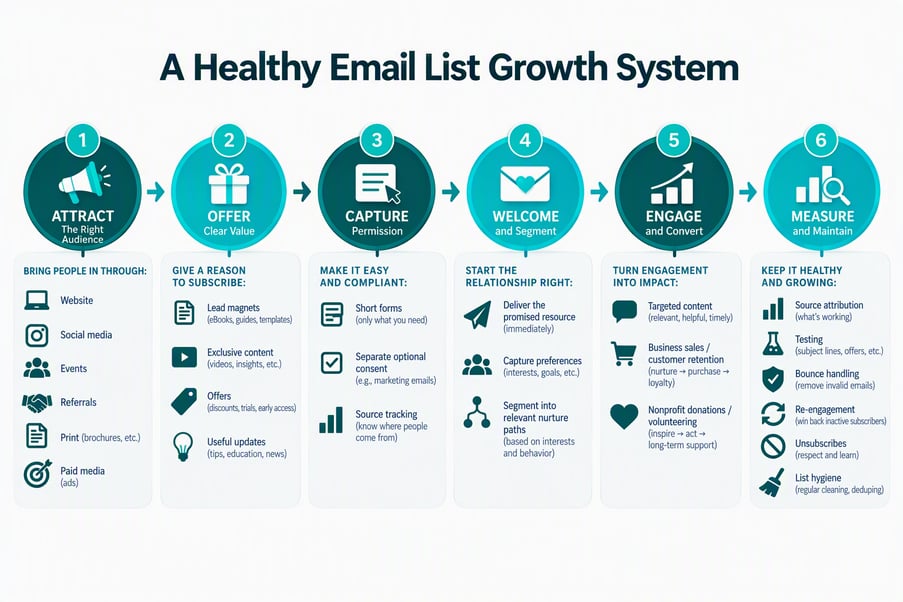
A Practical Email List Management Process
- Record the acquisition source. Know which form, event, ad, partner, QR code, or interaction generated each subscriber.
- Preserve consent information. Record what the person agreed to receive, when, and how.
- Apply useful segmentation. Start with a few actionable groups based on source, interest, lifecycle stage, customer or donor status, or engagement.
- Trigger the appropriate welcome flow. Deliver the promised value and set expectations.
- Continue with relevant nurture. Use educational content, stories, resources, offers, invitations, or appeals appropriate to that segment.
- Monitor meaningful behavior. Track clicks, conversions, donations, purchases, registrations, replies, bounces, complaints, and unsubscribes—not just opens.
- Re-engage selectively. Give inactive subscribers a clear choice to stay, update their preferences, or leave.
- Suppress and clean. Remove invalid addresses and ensure unsubscribed contacts cannot be accidentally re-added.
- Test and improve. Compare acquisition sources, offers, forms, segments, content, cadence, and outcomes.
Frequently Asked Questions About Email List Building
Should I buy an email list?
No. Although CAN-SPAM does not establish a general U.S. opt-in requirement, purchased lists create substantial trust, data-quality, deliverability, and platform-policy risks. Many leading email platforms prohibit them. Building your own permission-based audience is the stronger long-term strategy.
What makes a targeted email list valuable?
A targeted list contains people who share a relevant interest, need, stage, behavior, or relationship with the organization. This allows a business or nonprofit to send content that is more useful than a generic full-list message. Segmentation can be based on interests, engagement, behavior, lifecycle stage, purchasing, giving, geography, or preferences.
How often should email list management happen?
Basic monitoring should happen continuously: process unsubscribes, suppress hard bounces, and watch complaints after every send. Review segment performance and data quality monthly, then conduct a deeper audit quarterly. The appropriate schedule may vary with list size and send volume.
Is a large email list always better?
No. A large list is useful only when its contacts are valid, permissioned, relevant, and reasonably engaged. Prioritize quality first, then grow through repeatable acquisition methods.
How long does it take to build a strong email list?
There is no universal timeline. Growth depends on existing traffic, audience size, offer quality, promotion, industry, and frequency of customer or supporter interactions. Sustainable list growth usually comes from consistently giving the right people useful reasons to subscribe.
Build a List That Supports the Whole Strategy
The goal is not to collect as many email addresses as possible. It is to build an audience your organization can serve, understand, and communicate with responsibly.
Emerald Strategic Marketing helps businesses and nonprofits develop connected email strategies that bring together list growth, audience targeting, content, automation and nurture, customer or supporter journeys, and meaningful measurement, rather than treating each email as an isolated campaign. This reflects Emerald’s broader approach of connecting platforms, data, workflows, audience strategy, and reporting around organizational goals.
If your organization is ready to strengthen its overall email marketing strategy, Emerald can help you identify the right audience, build a healthier list, and create a practical plan for turning new subscribers into lasting relationships.