The Best Free and Affordable Marketing Tools for B2B Companies in 2026
Not long ago, B2B marketers relied on fairly simple indicators to identify potential customers: a form submission, a webinar registration, or a demo request. Those signals still matter, but they no longer tell the full story.
In 2026, the majority of B2B buying research happens before a prospect ever speaks with a salesperson. Buyers use AI-powered search tools, private communities, peer networks, review websites, podcasts, social platforms, and company websites to evaluate solutions long before they raise their hand.
As a result, the organizations generating the most qualified opportunities are often the ones that recognize buyer intent signals before competitors do.
The challenge is that not all signals are created equal.
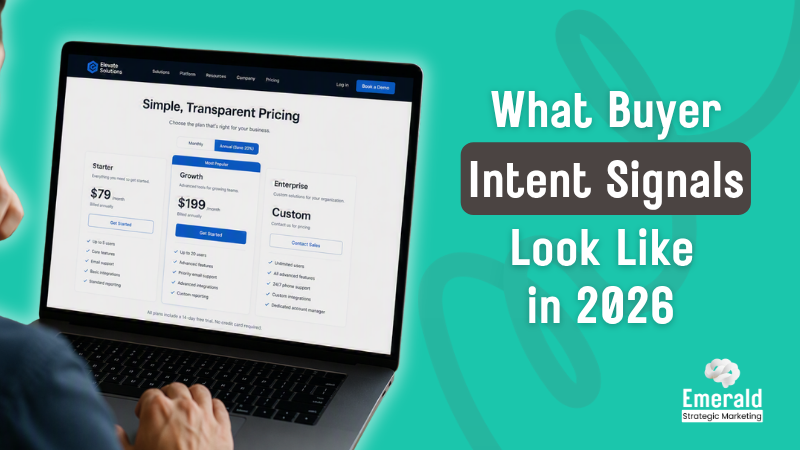
A website visit can indicate curiosity. A pricing page visit combined with competitor research, multiple stakeholder engagements, and increased topic consumption across digital channels may indicate an active buying cycle.
Organizations that understand the difference gain a significant advantage in lead generation, sales efficiency, and conversion optimization.
50% of B2B marketers say making intent data actionable is a top challenge.
Source: Rollworks
What Are Intent Buying Signals?
When business leaders ask, "what are intent buying signals?", the simplest answer is:
Buyer intent signals are behaviors that indicate a prospect or organization may be actively researching, evaluating, or preparing to purchase a product or service.
Think of them as digital breadcrumbs. Every interaction leaves clues about where a prospect is in their buying journey.
Examples include:
- Visiting pricing pages
- Reading solution comparison articles
- Downloading technical resources
- Reviewing case studies
- Attending webinars
- Viewing multiple service pages
- Engaging with competitor content
- Searching problem-specific keywords
- Requesting product documentation
- Starting conversations with sales representatives
However, the most valuable insight isn't a single action. The real value comes from identifying patterns.
A prospect who reads one blog post may simply be learning. But a prospect who reads five articles, visits pricing pages, downloads case studies, and shares content internally is likely much closer to making a decision.
That distinction matters.
Understanding Buyer Intent Signals in 2026
The biggest shift in 2026 is that buying behavior has become less visible.
Many decision-makers now use AI tools to conduct research, ask questions, compare vendors, and summarize information without ever clicking through to multiple websites.
This creates what many marketers now call the "dark funnel." The dark funnel consists of research activities that happen outside your direct visibility.
Examples include:
- AI-assisted research
- Private Slack communities
- Industry forums
- Peer recommendations
- Internal buying committee discussions
- ChatGPT and Copilot conversations
- Review platform research
- Industry-specific groups
Watch our quick explainer video below to learn more
about the three types of buyer intent signals ⬇️
Because of this shift, modern marketers must expand their definition of intent data.
Today, buyer intent typically falls into three categories:
First-Party Intent Signals
These are signals generated from your own digital properties.
Examples include:
- Website visits
- Repeat visitors
- Content downloads
- Email engagement
- Demo requests
- Chat interactions
- Webinar attendance
These are typically the most reliable signals because prospects are directly engaging with your organization.
Second-Party Intent Signals
These come from trusted partners.
Examples include:
- Association events
- Joint webinars
- Industry publications
- Technology partners
- Referral programs
Second-party signals often provide valuable context about audience interests.
Third-Party Intent Signals
These signals come from external research behavior.
Examples include:
- Topic research across publisher networks
- Review site activity
- Competitive comparisons
- Industry content engagement
- Technology evaluation behavior
These insights can help identify accounts before they discover your company.
The Most Valuable Buyer Intent Signals in 2026
Not all intent signals deserve equal attention.
High-performing B2B marketing teams increasingly focus on combinations of signals rather than individual actions.
The strongest indicators often include:
Multiple Pricing Page Visits
A prospect visiting pricing information repeatedly is rarely doing so by accident.
When combined with additional engagement, this often signals active solution evaluation.
Case Study Consumption
Case study engagement indicates buyers are attempting to validate outcomes and reduce risk.
This is especially important for executive decision-makers.
Competitive Research
Prospects reading comparison pages, alternative solution content, or competitor analyses often signal purchasing intent.
Buying Committee Activity
One of the strongest signals in B2B is when multiple stakeholders from the same organization engage with your content.
For example:
- IT Director reading security content
- CFO downloading ROI resources
- Operations leader reviewing case studies
- Executive leadership viewing strategy content
This indicates an active buying committee has likely formed.
Hiring Activity
Companies hiring for positions related to your solution often reveal emerging needs.
Examples:
- Hiring cybersecurity professionals
- Building automation teams
- Expanding IT departments
- Growing finance operations
Hiring often precedes technology investments.
Technology Changes
New platform implementations, mergers, acquisitions, business expansions, or leadership changes frequently trigger buying cycles.
These are signals many organizations overlook.
How to Evaluate Buyer Intent Signals
The biggest mistake organizations make is treating every lead equally.
A content download and a pricing page visit should not carry the same weight.
Modern lead scoring models evaluate intent using four factors:
1. Recency
How recently did the action occur?
Intent decays quickly.
A pricing page visit yesterday is more meaningful than one from six months ago.
2. Frequency
How often has the prospect engaged?
Repeated engagement usually indicates growing interest.
3. Depth
How close was the activity to a buying decision?
A blog visit is typically top-of-funnel.
A pricing inquiry is typically late-stage.
4. Stakeholder Involvement
How many individuals from the same company are engaging?
Multiple stakeholders almost always increase lead quality.
Organizations that score prospects using these factors typically prioritize resources more effectively than those relying on simple lead volume metrics.
How to Qualify a Sales Lead Using Intent Data
Business leaders frequently ask how to qualify a sales lead more accurately without overwhelming sales teams.
Intent data provides the answer.
Instead of asking whether someone fits your ideal customer profile alone, ask:
Does the prospect fit our target audience?
Consider:
- Industry
- Revenue
- Employee size
- Geography
- Technology stack
Are they demonstrating buying behavior?
Look for:
- Product research
- Case study engagement
- Pricing evaluation
- Competitive comparisons
Is there organizational alignment?
Determine:
- Who is involved?
- Are budget owners engaged?
- Are technical decision-makers involved?
- Has executive leadership entered the conversation?
Is there urgency?
Timing indicators include:
- New business initiatives
- Technology transitions
- Compliance requirements
- Growth plans
- Operational challenges
When these factors align, sales teams can focus on genuine opportunities rather than chasing every hand raiser.
How Buyer Intent Signals Improve Conversion Rates
Organizations that leverage intent data effectively often see improvements in:
Lead Quality
Marketing focuses resources on accounts actively researching solutions.
Sales Productivity
Sales spends less time prospecting cold accounts.
Personalization
Teams can tailor messaging around observed interests and behaviors.
Faster Sales Cycles
Prospects are engaged during active evaluation periods instead of months before they are ready.
Improved Marketing ROI
Campaign spend targets accounts with demonstrated buying activity.
The result is a more predictable revenue engine.
Instead of generating more leads, organizations generate more qualified opportunities.
And in today's competitive B2B marketplace, that distinction matters more than ever.
The Future of Buyer Intent in 2026 and Beyond
Buyer intent is evolving from simple click tracking to predictive intelligence.
The next generation of intent strategies will increasingly incorporate:
- AI-powered account scoring
- Buying committee identification
- Predictive analytics
- Conversation intelligence
- Behavioral pattern recognition
- Real-time personalization
The organizations that win will not necessarily have the largest databases.
They will have the clearest understanding of why their prospects are engaging and what those behaviors reveal about future purchasing decisions.
Intent isn't just about finding buyers.
It's about understanding when they're ready to buy.
Need help turning buyer intent into new clients?
We can help you do that! ⬇️

Frequently Asked Questions
1. What are the strongest buyer intent signals in B2B marketing?
The strongest buyer intent signals typically include multiple pricing page visits, case study downloads, competitor research, demo requests, buying committee engagement, review site activity, and repeated visits from the same organization. Multiple signals occurring together are typically more predictive than a single action.
2. How is buyer intent different from traditional lead scoring?
Traditional lead scoring often focuses on demographic fit and engagement volume. Buyer intent focuses on actual buying behavior and current research activity. Intent helps identify whether a prospect is actively evaluating solutions now, rather than simply fitting the ideal customer profile.
3. How can intent data improve marketing conversion rates?
Intent data improves conversion rates by helping marketers focus messaging, content, advertising, and sales outreach on prospects who are actively researching solutions. This reduces wasted effort, improves personalization, shortens sales cycles, and increases the likelihood of converting qualified opportunities into customers.