Customers Are Tired of AI Content. So Why Are Businesses Creating More of It?
For years, businesses have treated social media primarily as a way to stay visible to customers, build relationships, share company news, and generate leads.
But social media now plays another important role:
Helping your business appear in AI-generated search results.
New research highlighted by Social Media Today suggests that active social media channels are becoming part of the information AI-powered search tools use when generating answers about companies, products, services, and industries.
That means the social post you publish today might do more than reach the people following your company. It could also contribute to your company's overall digital footprint and how discoverable your brand is when someone searches with AI. And for businesses already struggling to post consistently, that's another reason social media shouldn't be an afterthought.
AI Search Is Changing What It Means to Be "Visible"
Traditional search visibility largely meant one thing: showing up on Google. That's changed.
People can now research companies and ask questions through tools and experiences such as ChatGPT, Google AI Overviews, Google AI Mode, Gemini, Copilot, and other AI-powered platforms. More importantly, those tools don't necessarily rely on the same sources.
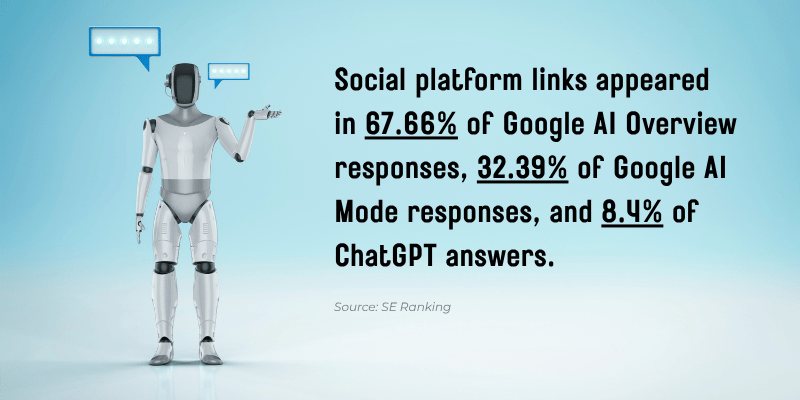
The study by SE Ranking analyzed 100,000 keywords across multiple brand niches. Social platform links appeared in 67.66% of Google AI Overview responses, 32.39% of Google AI Mode responses, and 8.4% of ChatGPT answers.
The platforms being surfaced also differed. YouTube was the most commonly cited social source in Google AI Overviews, while Reddit and LinkedIn were the leading social platforms referenced by ChatGPT in the study.
One particularly interesting finding for marketers was the difference between branded and non-branded searches. In Google's AI Mode, social media sources appeared in 39.34% of branded-query responses and 48.58% of non-branded-query responses.
In other words, social content isn't just potentially useful when someone already knows your company's name. It can also appear when people are searching more broadly around a topic.
For companies and organizations alike, that might look like:
- "What should I look for in an [X] provider?"
- "How can a nonprofit improve its [X]?"
- "What is the difference between [X] and [Z]?"
- "How do I improve my organization's [X]?"
- "What should I outsource instead of hiring internally?"
Those are exactly the kinds of questions businesses should be answering across their digital presence.
Social Media Isn't Replacing SEO
Before everyone starts publishing five LinkedIn posts a day, there's an important distinction to make. The research does not mean posting frequently automatically makes your company rank higher in AI results.
In fact, the platforms AI tools reference can change significantly. Social Media Today notes that Reddit's share of ChatGPT search citations reportedly dropped 86.4% in four days in August 2026, illustrating just how quickly the AI search landscape can change.
There's a bigger lesson here > Businesses shouldn't build their entire visibility strategy around one platform.
Your website, articles, social channels, videos, third-party mentions, reviews, thought leadership, and other online content collectively create signals about who you are and what you know. Social media is one piece of that ecosystem.
That's why we believe businesses need to start thinking less about "SEO vs. social media vs. AI" and more about how all of those channels work together.
The Problem: Most Businesses Know They Should Post, But Don't
Here's where strategy often collides with reality. You start the year determined to post more consistently. For a few weeks, everything goes well. Then someone gets busy. A client project takes priority. Nobody knows what to post. The person who normally approves content is unavailable. Two weeks pass. Then a month. Suddenly someone asks: "When was the last time we posted on LinkedIn?"
Sound familiar?
Consistency is one of the hardest parts of managing a business social media presence. The solution usually isn't "try harder." It's creating a better system.
7 Ways to Become More Consistent on Business Social Media
1. Stop Starting From Scratch Every Week
One of the biggest causes of inconsistent posting is the question: "What should we post today?" Instead, establish several repeatable content pillars.
For example, a nonprofits pillars might include:
- Community impact
- Mission Education & Awareness
- Volunteer Stories & Opportunities
- Donor & Supporter Spotlights
- Success Stories
- Behind the Scenes
- Educational Tips & Resources
- Events & Community Involvement
- Ways to Get Involved
- Organizational News & Milestones
And a B2B company's pillars might include:
- Industry education
- FAQs and customer questions
- Company culture
- Client problems and solutions
- Thought leadership
- Tips and how-to content
- Company news
- Community involvement
Now you're choosing a topic from a framework instead of staring at a blank screen.
2. Build a Content Calendar
 You don't need to know every word you're going to publish three months from now. You just do need a plan.
Start by mapping important dates, events, campaigns, webinars, company announcements, seasonal topics, and industry moments. Then fill the remaining space with evergreen educational content.
A calendar turns social media from a last-minute task into part of your marketing operation.
3. Turn One Idea Into Multiple Pieces of Content
Companies and organizations often have more content than they realize.
A webinar could become:
- A LinkedIn post
- Several short video clips
- An FAQ
- A blog
- A quote graphic
- An email
- A short educational post
A customer question could become an FAQ on your website, a LinkedIn post, a short video, and a future article. We call this content repurposing. This is one of the easiest ways to stay consistent without constantly creating something new.
Create once. Distribute intelligently.
4. Write Content in Batches
Creating one post every time you need one is inefficient. Instead, dedicate a block of time to producing several posts at once.
If you've established your content pillars and calendar first, batching becomes much easier because you're no longer spending most of that time deciding what to talk about.
5. Answer the Questions Customers Are Actually Asking
This is especially valuable as AI-assisted discovery grows. Pay attention to the questions prospects/donors ask during calls, in emails, during meetings, and through your website. Then turn those questions into useful public content.
Instead of posting: "We offer XYZ service. Contact us today!"
Create content around: "How do I know whether my business needs XYZ?"
The second version actually helps someone solve a problem.
Educational, information-led brands can have an advantage in AI visibility. An independent analysis of Similarweb's 2026 Generative AI Visibility Index found specialist and education-led brands often performed better in generative-AI visibility than their level of branded search demand might suggest.
6. Don't Post Just to Say You Posted
Consistency doesn't mean filling a calendar with meaningless content. Before publishing something ask, "Would our ideal audience learn something, understand us better, or find this useful?" If the answer is no, reconsider the post.
Five forgettable posts aren't necessarily more valuable than one genuinely useful one. And don't create content solely for AI systems. Your first audience is still human.
7. Make Someone Responsible for Consistency
This one sounds obvious, but it's often the missing piece. If everyone is responsible for social media, sometimes no one is responsible for social media.
Someone needs ownership of:
- Planning
- Writing
- Approvals
- Scheduling
- Publishing
- Monitoring
- Measuring results
That doesn't mean one employee has to create everything. Sales, leadership, customer service, operations, and subject-matter experts can all contribute ideas.
But someone needs to keep the engine running.
Social Media Is Becoming Part of a Much Bigger Visibility Strategy
The biggest takeaway from this research isn't that businesses need to post more. It's that the lines between social media, search, content, brand awareness, and AI discovery are becoming increasingly blurred.
Social posts aren't living in isolation anymore. Neither are blogs. Neither are videos. Neither are your website pages.
Together, they create the digital footprint that helps people, search engines, and increasingly AI platforms understand what your company does and where your expertise lies. That's why consistency matters. Not because your business needs to "feed the algorithm." Because every useful piece of content gives your company another opportunity to clearly communicate:
-
This is who we are
-
This is what we know
-
This is who we help
-
This is what we can help them solve
At Emerald, this is how we believe businesses and nonprofits should approach modern marketing: not as disconnected tactics, but as a connected system. Your website, social media, content, SEO, AI visibility, data, and campaigns should reinforce each other.
Because getting found isn't about being everywhere. It's about consistently showing up in the right places with something worth finding.